Price Comparison of AI Voice Tools for Czech: Dubbing, Voiceover, and Support Bot
AI voice tools for Czech in 2026 fall into three practically distinct categories: dubbing for converting video into another language, voiceover for ads, e-learning, and corporate videos, and voice bots for phone or web support. At first glance they look similar, but in terms of pricing and technology they are different products. One service charges by characters, another by minutes of generated audio, and another by number of calls, concurrent lines, or real-time transcription and synthesis.
For Czech, several specifics also matter: the quality of pronunciation of names and anglicisms, handling of diacritics, the ability to maintain intonation in longer sentences, support for timing to video, and licensing terms for commercial deployment. Price alone, without these details, says almost nothing. A cheap voice can become more expensive the moment it requires manual transcription, pronunciation fixes, and a new export after every script change.
The article uses indicative prices from publicly available price lists and official service terms valid or commonly listed at the turn of 2025 and 2026. For enterprise tools, the final offer often changes depending on volume, license type, number of users, and region. That is why it is important to treat the listed amounts as a comparison framework, not as a binding quote.
If the goal is to choose the right type of tool, it is worth first distinguishing whether you need an AI tool for one-off audio production, video localization, or operational voice communication. This difference has the biggest impact on total costs.
How to read AI voice service pricing: what you are actually paying for

Illustrative context for the topic continues below.
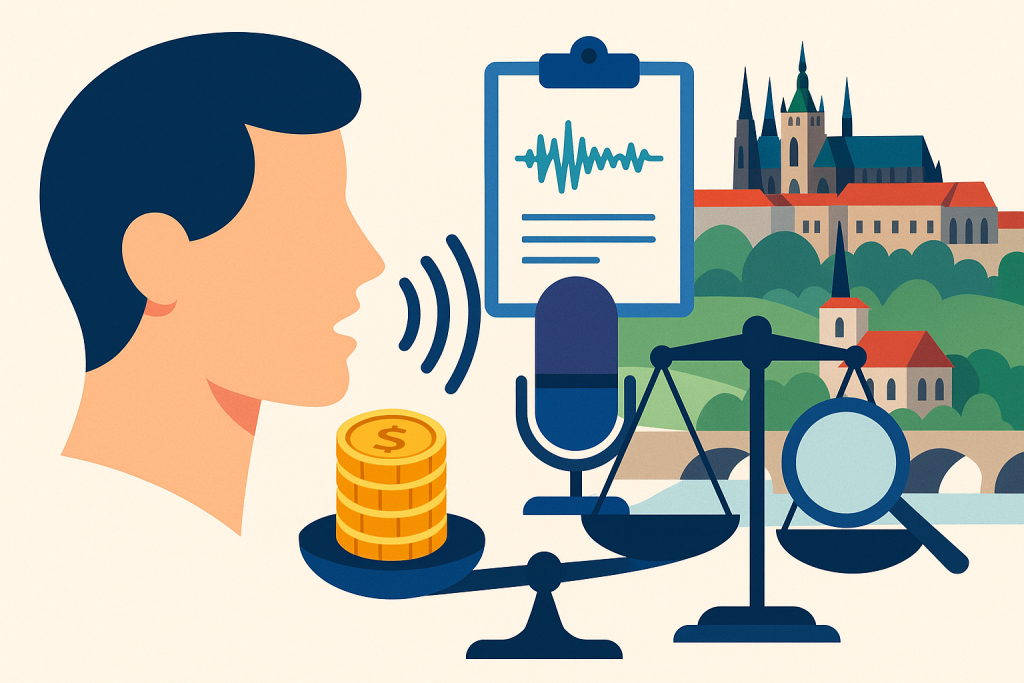
The biggest mistake when comparing AI voice tools is comparing incomparable units. Text-to-speech platforms typically charge by characters or by minutes of generated audio. Dubbing platforms add pricing for transcription, translation, video synchronization, and sometimes even watermark-free export. Voice bots then often charge separately for speech-to-text, text-to-speech, the LLM layer, telephony operations, and sometimes also a fee for a number or SIP integration.
What to do: Before choosing, calculate the price per actual output: for example, 10 minutes of finished video in Czech, 1 hour of e-learning, or 1,000 handled phone calls.
Who it’s for: Marketing teams, video production teams, and call center operations that need to justify the budget to management.
When not to use this: When comparing only trial hobby use. For a one-off short clip, the price difference may be negligible, and speed and interface simplicity will matter more.
In practice, it pays to track mainly four cost items:
- the input unit – characters, minutes, hours, or calls,
- the license – whether commercial use is included in the basic plan,
- editing – how much pronunciation fixes, re-export, and text changes cost,
- integration – API, telephony, CRM, or video workflow.
For standard voiceover, the tool price is usually only part of the cost. If the service cannot reliably handle Czech stress, numerals, or abbreviations, the time saved by cheap synthesis is quickly lost in manual text cleanup. Similarly, in dubbing, a cheaper plan can end up meaning more expensive production if it does not offer precise timing or preservation of pauses between sentences.
For orientation in the broader market, overviews focused on AI video generators are also useful, because this is exactly the category where automatic dubbing and narrated voiceovers are increasingly being added as part of a single platform.
Voiceover for Czech: ElevenLabs, Google Cloud, Microsoft Azure, and Amazon Polly

For pure Czech voiceover, it currently makes the most sense to compare four types of services: creative voice generation with an emphasis on naturalness, robust cloud TTS for applications, enterprise platforms with broad API support, and cheaper synthesis for system announcements. Typical representatives are ElevenLabs, Google Cloud Text-to-Speech, Microsoft Azure AI Speech, and Amazon Polly.
ElevenLabs: naturalness and editing, but watch the license and volume
ElevenLabs is among the strongest choices for marketing voiceover, YouTube, training, and short corporate videos. It offers Czech, voice design, voice cloning, intonation control, and an editor in which text can be changed without a complete new workflow. Indicative pricing for standard plans is in the range of tens of dollars per month, while enterprise offers are custom. For larger audio volumes, however, the price can rise quickly depending on the number of characters and the license type.
What to do: Use ElevenLabs where natural delivery matters and where the script is often adjusted only after the video is approved.
Who it’s for: Content creators, agencies, and internal L&D teams.
When not to use this: For phone systems and system announcements with high volume, where low cost per million characters and a stable API matter more than voice expressiveness.
Official website: https://elevenlabs.io/
Google Cloud Text-to-Speech: strong infrastructure, suitable for applications
Google Cloud Text-to-Speech has long been built on robust infrastructure and good integration into applications. It offers standard and neural voices, SSML, and billing by number of processed characters. Indicatively, pricing ranges from single digits to tens of dollars per million characters depending on the voice type. The advantage is scalability and availability within Google’s cloud ecosystem; the disadvantage for creative production is often less pronounced naturalness than with specialized voice AI platforms.
What to do: Deploy Google TTS where large volumes of Czech voice need to be generated from an application or backend.
Who it’s for: SaaS developers, product teams, and companies with their own application.
When not to use this: When the goal is an ad spot or emotional voiceover where even a slight robotic trace is audible.
Official website: https://cloud.google.com/text-to-speech
Microsoft Azure AI Speech: a good compromise between price, API, and enterprise deployment
Azure AI Speech supports TTS, STT, voice fonts, and translation scenarios. In Czech, it is especially interesting for companies already using the Microsoft ecosystem. Indicative pricing is usually calculated by million characters or by processing hours for related services, depending on voice type and region. Its strengths are enterprise management, security policy, and broader integration into corporate IT.
What to do: Choose Azure when a company has internal development and needs one contract, identity management, and auditable deployment.
Who it’s for: Mid-sized and large companies, contact centers, and internal portals.
When not to use this: When it is a small creative project without IT support and without the need for API integration.
Official website: https://azure.microsoft.com/products/ai-services/ai-speech
Amazon Polly: cheaper synthesis for utilitarian use
Amazon Polly remains a relevant choice for system announcements, text reading in applications, or information kiosks. It offers billing per million characters and standard as well as neural voice variants. Czech is supported, but in creative voiceover quality Polly is not usually the first choice. In terms of pricing, however, it can make sense where volume and reliability matter most.
What to do: Deploy Polly for utilitarian text reading, notifications, and internal applications.
Who it’s for: Companies running on AWS and teams with a strong focus on budget.
When not to use this: For video dubbing and brand voice, where naturalness and delivery style are decisive.
Official website: https://aws.amazon.com/polly/
AI video dubbing into Czech: HeyGen, Synthesia, and Rask AI
In dubbing, it is not just about the voice itself. What matters is the combination of speech transcription, translation, synchronization to shot length, lip adjustments or at least preservation of speech rhythm, and easy export into an editor. This is exactly where HeyGen, Synthesia, and Rask AI are most often compared.
HeyGen: fast dubbing and localization of talking-head videos
HeyGen is known mainly for avatars, but in practice it is also often used for video translation and dubbing. For Czech outputs, the benefit is a simple workflow: upload video, transcribe, translate, choose a voice, and export. Indicative pricing starts in the range of tens of dollars per month, while higher volumes and team features are usually significantly more expensive. For longer video series, it is necessary to watch the minute limits in the plan.
What to do: Use HeyGen for internal training, onboarding, and fast localization of product videos into Czech.
Who it’s for: HR, enablement teams, and SaaS companies with regular video production.
When not to use this: For TV or image videos where detailed manual voice direction and post-production are required.
Official website: https://www.heygen.com/
Synthesia: strong enterprise platform, dubbing as part of the video workflow
Synthesia offers video creation with avatars, but also handles voiceover and multilingual localization. For Czech, what matters is that it allows script, voice, visuals, and updates to be unified in one environment. Indicative pricing for standard plans starts at tens of dollars per month, while enterprise offers are custom and often include SSO, brand governance, and team collaboration.
What to do: Choose Synthesia if a company regularly updates the same video in multiple languages and does not want to deal with external production every time.
Who it’s for: Larger companies, training departments, and global teams.
When not to use this: For one-off short clips where a monthly subscription and production limitations would not make economic sense.
Official website: https://www.synthesia.io/
Rask AI: a specialist in video translation and localization
Rask AI positions itself as a tool for video localization and translation, including dubbing and work with multiple languages. For the Czech market, it is especially relevant in the creator economy, e-learning, and marketing videos that are quickly translated into several language versions. Indicative pricing is usually tied to the number of video minutes and the plan type.
What to do: Test Rask AI on a pilot package of 20 to 30 minutes of content and measure how much time it saves compared to manual localization.
Who it’s for: Agencies, educational platforms, and creators with multiple language versions.
When not to use this: When very precise Czech terminology is needed in a regulated field and the output cannot be approved without human language review.
Official website: https://www.rask.ai/
Voice support bot: where the price breaks on integration, not on the voice
For support bots, the Czech synthetic voice itself is only one part of the puzzle. Total cost is often influenced more by speech recognition, telephony integration, CRM, knowledge base, and LLM orchestration. Real platforms include, for example, Google Dialogflow, Microsoft Copilot Studio combined with voice services, Amazon Connect, or specialized voice AI platforms such as PolyAI.
What to do: Calculate the cost of a support bot by resolved request, not by minute of call. Only then does it become clear whether automation is actually saving operations costs.
Who it’s for: Customer support, receptions, dispatching, and order lines.
When not to use this: For complex complaints, sensitive medical or legal cases, and situations where human judgment and empathy are needed.
Google Dialogflow CX typically charges by number of requests or by audio processing time depending on the specific configuration. Amazon Connect combines contact center usage pricing with additional AI services. Microsoft deployment, in turn, often relies on a broader licensing bundle. PolyAI is usually priced individually and targets more of the enterprise segment. All of these options have one thing in common: a pilot is usually cheaper than live operation, because production adds monitoring, operator fallback, call recording, security, and scenario testing.
Official links: https://cloud.google.com/dialogflow, https://aws.amazon.com/connect/, https://www.microsoft.com/microsoft-copilot/microsoft-copilot-studio, https://poly.ai/
Practical scenarios: how much Czech can cost in real operation
A price list is not enough to make a decision. What matters is recalculating costs for a specific use case.
Scenario 1: 10 minutes of product video with Czech voiceover
If a company needs 10 minutes of narrated product video, it may pay indicatively low tens of dollars per month within a subscription for a creative tool like ElevenLabs, but also invest time in pronunciation adjustments and editing. With cloud TTS such as Google or Azure, the synthesis itself may be cheaper, but the output will more often need post-production intervention. The result: for marketing video, a more expensive plan is often cheaper in the total sum of work.
What to do: For a short video, calculate the editor’s correction time as well, not just the credit price.
Who it’s for: Smaller marketing teams and B2B companies with regular product videos.
When not to use this: When the voice is meant to be part of a radio campaign or TV spot with high demands on acting performance.
Scenario 2: 5 hours of e-learning in three language versions
Here, by contrast, a platform that can handle script, updates, and localization in one workflow starts to pay off, typically Synthesia or HeyGen. The reason is simple: every text adjustment affects multiple languages, and manually regenerating voice chapter by chapter would be time-consuming and expensive. Indicatively, the software may cost from the lower hundreds of dollars per month upward depending on the number of minutes and users, but the savings come in updates.
What to do: Create one master script and only then generate the Czech, English, and German versions.
Who it’s for: L&D departments, compliance training, and onboarding across multiple countries.
When not to use this: If the training is recorded once by a human instructor and will not change in the long term.
Scenario 3: 3,000 incoming support calls per month
For a voice bot, the key factor is not the voice price but the rate of automatic request resolution. Even cheap TTS is expensive if the bot does not understand Czech variants of addresses, names, or slang phrasing and transfers most calls to an operator. Indicatively, the budget here consists of voice minutes, STT, LLM queries, phone charges, and implementation. That is why it is realistic for a pilot to cost tens of thousands of Czech crowns, while production deployment with CRM integration will go significantly higher.
What to do: First deploy only narrowly defined scenarios, such as order status, opening hours, or rescheduling an appointment.
Who it’s for: E-shops, logistics, and service lines with recurring questions.
When not to use this: When calls are mostly non-standard and each requires an individual solution.
Limits of Czech: where AI voice still runs into problems
Even high-quality tools have weak spots in Czech. Most often these involve declension of foreign names, correct reading of abbreviations, handling of phone numbers, addresses, English product names, and switching between formal and informal tone. In dubbing, the problem of sentence length is added: Czech translation tends to be longer than the English original, so it is harder to preserve synchronization with the picture.
What to do: Create an internal pronunciation dictionary for names, brands, abbreviations, and numbers and use it across projects.
Who it’s for: Companies with specialized terminology, for example in finance, healthcare, or industry.
When not to use this: Without human review in regulated sectors where incorrect pronunciation or translation can change the meaning.
A significant limitation also concerns law and licensing. Not every service allows unrestricted commercial use, voice cloning, or distribution of outputs to clients. For cloned voices, verifiable consent from the voice owner is required. Some plans may also limit the number of projects, team seats, or priority processing.
Another common problem is vendor lock-in. If a company builds its entire training catalog or voice assistant on one platform, migration can be complicated due to proprietary voices, project files, and pronunciation settings. That is why it is worth exporting scripts, subtitles, dictionaries, and audio metadata outside the tool.
How to choose by budget: simple decision rules
A sensible selection can be simplified into a few rules.
- For a lower budget and one-off voiceovers, ElevenLabs or cloud TTS makes sense depending on whether naturalness or API is the deciding factor.
- For regular video localization, HeyGen, Synthesia, or Rask AI is more practical because they handle the whole workflow, not just the voice.
- For voice support, the platform needs to be chosen based on integrations and scenario accuracy, not on a sample of one nice voice.
- For enterprise deployment, Azure, Google Cloud, or the Amazon ecosystem is often more advantageous if the company already runs infrastructure from the same vendor.
What to do: Test at least two tools on the same Czech script containing names, numbers, anglicisms, and longer compound sentences.
Who it’s for: Anyone choosing a tool for more than one project.
When not to use this: When the decision is based only on a vendor demo without your own test on real content.
FAQ
Which AI voice tool has the most natural voice in Czech?
For creative voiceover, ElevenLabs is among the most commonly considered options. For applications and system announcements, however, Google Cloud, Azure, or Amazon Polly may be more suitable depending on price, API, and infrastructure.
What is cheaper: AI voiceover or a human voice actor?
For short outputs that are updated often, AI is usually cheaper. For campaigns, image videos, and highly stylized spots, a human voice often pays off more because of quality and the lower risk of unnatural delivery.
Is it possible to use a cloned voice commercially?
Yes, but only according to the terms of the specific service and with verifiable consent from the person whose voice is being cloned. Without proper licensing and consent, it is both a legal and reputational risk.
How is pricing calculated for a support bot?
It usually consists of multiple items: speech recognition, voice synthesis, LLM processing, telephony operations, integration, and sometimes also platform fees or the number of concurrent sessions.
Does AI dubbing make sense for Czech?
Yes, especially for internal training, product videos, YouTube, and localization of larger volumes of content. It makes less sense where acting interpretation or very precise synchronization with the picture is crucial.
Conclusion
In 2026, the question is no longer whether AI voice works in Czech, but for which type of task it is economically and qualitatively suitable. For voiceover, a specialized tool with a natural voice leads the way; for mass applications, cloud TTS infrastructure wins; for dubbing, the entire video workflow is decisive; and for support bots, integration and the success rate of automatic request resolution matter most.
The most reliable approach is simple: take your own Czech script, calculate the price per actual output, test two or three services, and watch not only the voice but also editing time, licensing, and operational limits. That is exactly where the difference between a cheap tool and a cheap result is decided.
Recommended AI stack for implementation
Choose tools according to your budget and level of automation. Below is a direct overview of services for implementing the project.
| Service | Service description | Offer |
|---|---|---|
| NordVPN | VPN service for privacy protection and secure connections. | Open offer |
| Semrush | SEO and marketing platform for analysis and traffic growth. | Open offer |
| Make | Advanced visual automation for workflows and integrations. | Open offer |
| Hostinger | Web hosting and domains for fast website launch. | Open offer |
| Fiverr | Marketplace for freelancers and external specialists. | Open offer |
| Adobe | Creative tools for graphics, video, and digital content. | Open offer |
| Canva | Online design tool for graphics, presentations, and social media. | Open offer |
| Jasper | AI tool for marketing copy and content campaigns. | Open offer |
Note: We use affiliate links for listed services. If you purchase through them, we may earn a commission at no extra cost to you.
Links in the article
- https://elevenlabs.io/
- https://azure.microsoft.com/products/ai-services/ai-speech
- https://aws.amazon.com/polly/
- https://www.heygen.com/
- https://www.synthesia.io/
- https://www.rask.ai/
- https://aws.amazon.com/connect/
- https://www.microsoft.com/microsoft-copilot/microsoft-copilot-studio
- https://poly.ai/
Sources of illustrative images
The original illustrative image was created using the OpenAI Images API.
Doporučení ke čtení

Comparison of AI tools for preparing business proposals: quality vs speed

EarnMoney and Fortunes Fortuna: an honest look at the project inspired by AIvyber.cz
Notion AI vs. Coda AI: which tool can handle internal documentation without chaos