EarnMoney and Fortunes Fortuna: an honest look at the project inspired by AIvyber.cz
At AIvyber.cz, we often deal with how to turn an AI tool into something more practical than just a nice chat demo. The EarnMoney project, whose public-facing part is the website Fortunes Fortuna, is a good example of exactly this kind of thinking: it does not begin with a promise that AI will solve everything, but with a narrow operational problem.
That problem sounds simple: small businesses and freelance teams lose money not because they do not have enough apps, but because their leads, follow-ups, proposals, invoices, and work handoffs fall apart. Fortunes Fortuna tries to turn this mess into a concrete workflow.
This text is therefore not an advertisement. It is a transparent look at a project that was created as a practical experiment inspired by the AIvyber.cz style: take AI-assisted work, add process, security boundaries, and publicly show what is finished and what is still only a demonstration layer.
What Fortunes Fortuna actually offers
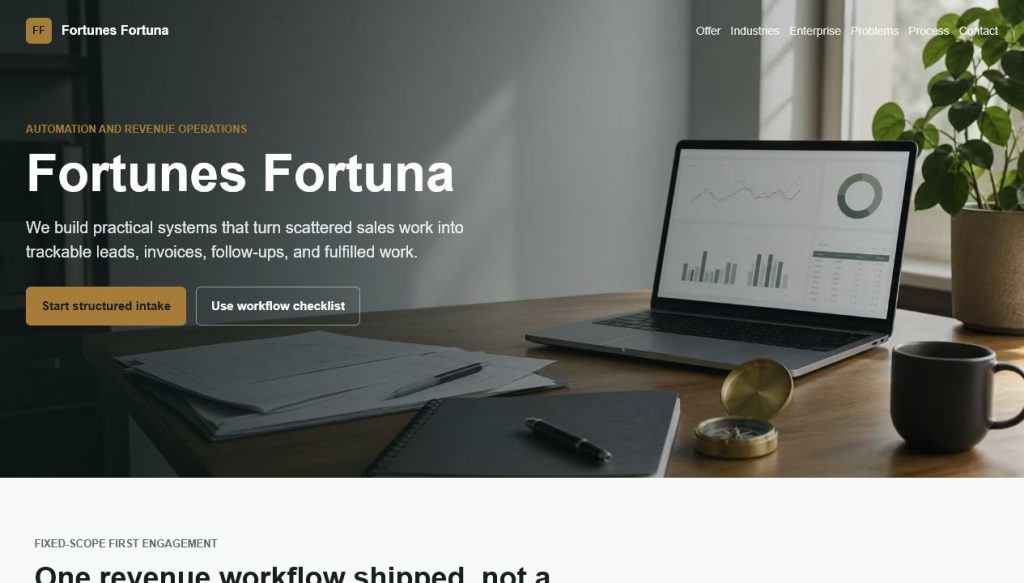
From the public website, it is clear that Fortunes Fortuna is not a classic catalog of AI tools or a general SaaS product. It is an offer of tightly scoped revenue operations systems. In practice, these are small operational systems around the following areas:
- capturing inquiries and placing them into a clear queue,
- follow-up after the first contact or a sent proposal,
- continuity between proposal, invoice, payment, and the start of work,
- a handoff checklist after a job is accepted,
- structured intake so vague requests without context do not have to be handled.
This is important because the project does not build its value on the phrase “we use AI.” The value is more in turning recurring operational chaos into fields, statuses, owners, deadlines, and next steps.
For AIvyber.cz readers, this is a useful example: AI can help with drafting copy, templates, structure, documentation, or checklists, but on its own it is not enough. The result has to end up in a process that a person can actually use.
Strong point: the project shows workflow instead of just describing a service
One of the better parts of the website is the demo lead follow-up board. It does not contain real client data, but a fictional example of an inquiry queue. In one place, you can see open leads, deadlines, pipeline estimate, response status, and a suggested next step.
That is essential for a project like this. If the website only claimed that it would “improve follow-up,” it would be weak. Here, a visitor can imagine a concrete mechanism: an inquiry comes in, gets a status, an owner, a due date, an estimated value, a suggested response, and a next action.
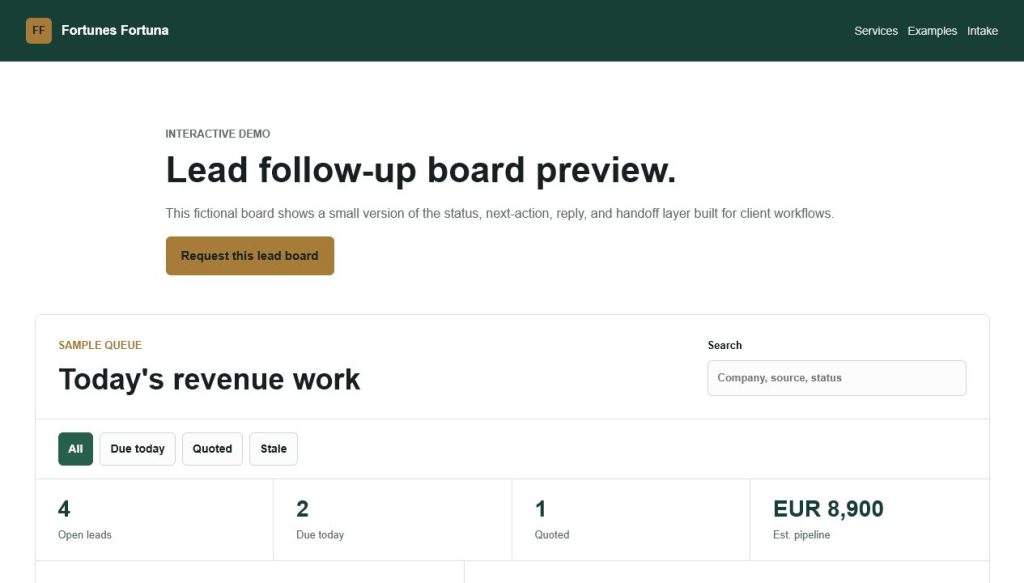
It also works well that the demo separates several layers of work. It is not just a contact list. It includes the lead problem, next action, suggested response, and process status. That is exactly where small businesses are often weak: the information exists, but it is not in one operational view.
On the other hand, it needs to be said clearly that the public website does not show a full live application with login, integrations, and a production CRM backend. For now, the public part feels mainly like a project presentation, static website, demo tools, and qualification path. That is not wrong if the goal is to get the first validated inquiries, but it would not be fair to confuse it with finished universal software.
Risk calculator: useful if we treat it as a directional model
Another part of the website is the lead response risk calculator. It tries to show how many opportunities a company may be losing when it responds to inquiries late, not at all, or without a clear owner.
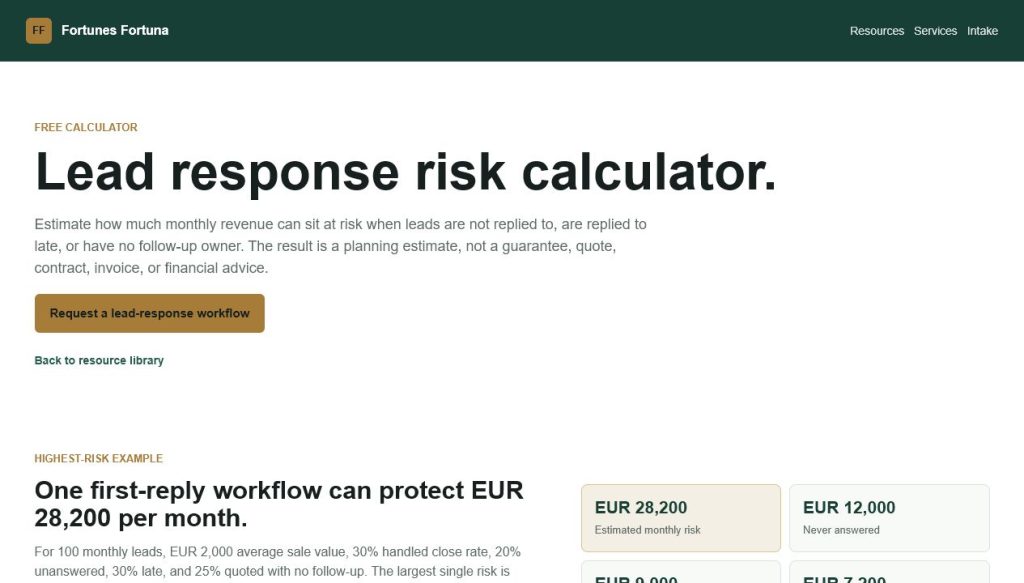
Practically speaking, it is a good content tool. It does not sell the service directly, but helps the visitor think about his own process. If a company knows how many leads it gets per month, what the average deal value is, and how many responses are being lost, it can make a rough estimate of the problem.
A positive point is that the calculator itself states its limits. It presents the result as a planning estimate, not as a financial guarantee, quote, contract, or investment advice. That is exactly the kind of caution that should be standard in AI and automation projects.
The limitation is, of course, the accuracy itself. The calculation can open a discussion well, but it cannot replace real data from CRM, invoicing, or analytics. If Fortunes Fortuna is to move toward stronger credibility, it would help to show an anonymized before-and-after example, or specific metrics from a real deployment.
The scope builder translates a vague idea into a first build well
The revenue workflow scope builder is, in my view, one of the most practical parts of the website. With similar projects, the problem is often that the client comes in with a sentence like “we need automation,” but does not know exactly where the process is leaking. The scope builder forces the question to be narrowed down.
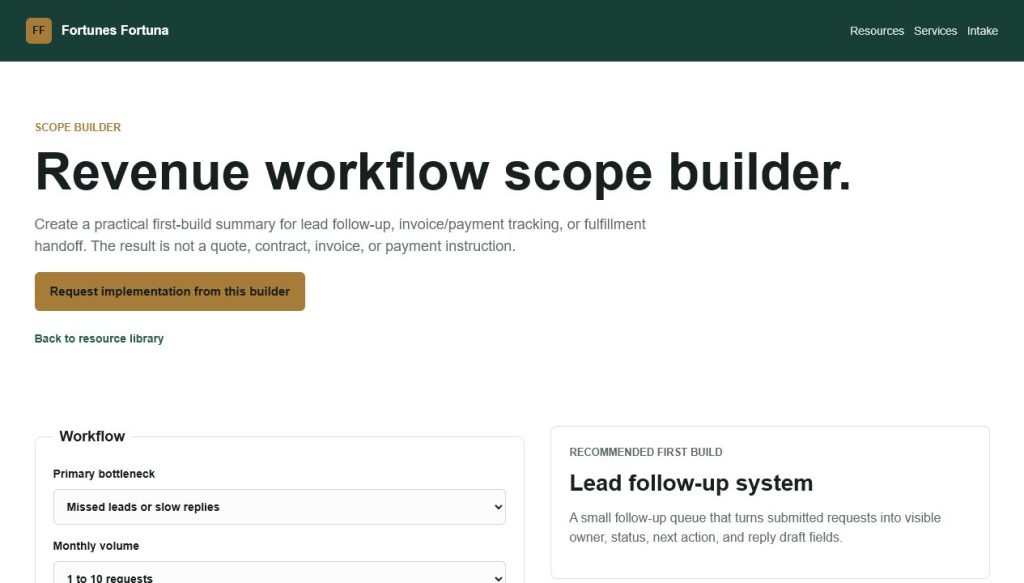
The output is not a major company transformation. It is a recommended first build: for example, a lead follow-up system, invoice/payment handoff, or fulfillment handoff. That is sensible, because the first version of a workflow should solve one pain point, not rebuild the entire company.
This is also a good lesson for AI projects in general. The worst brief is usually “build us an AI system.” A better brief is: “Every day, new inquiries from our form slip through the cracks; we need a queue with status, owner, deadline, and response.” That kind of brief can already be designed, tested, and handed over.
The intake form is especially strong thanks to draft text generated from fields
Structured intake is further proof that the project thinks in terms of process. The form does not just ask for a name and email. It guides the visitor through workflow type, main bottleneck, volume, timeline, current tools, target handoff, and success metric.
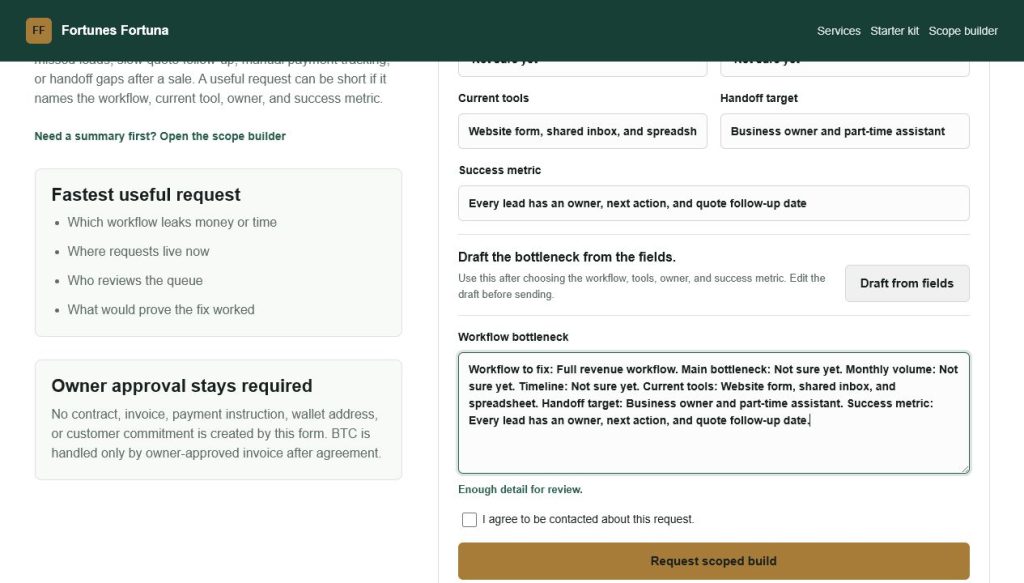
The “Draft from fields” feature is interesting. It creates a short project description draft from the completed fields. That is a small thing, but very practical: many people know what hurts, but cannot write a clear brief from it. Here, the form helps turn disconnected answers into text that can be sent for review.
I also consider the security boundaries a plus. The website repeatedly reminds visitors that customer commitments, invoices, payments, a BTC address, or movement of money require owner approval. In a project that touches revenue operations, that matters more than a flashy marketing sentence.
What worked well
The strongest part of the project is its narrow focus. Fortunes Fortuna does not try to be a tool for everything. It focuses on situations that are real for small businesses: someone fills out a form, a proposal goes out, follow-up is forgotten, an invoice is waiting, the work handoff is unclear.
The second plus is how demonstrative it is. The website includes a demo board, calculator, scope builder, checklists, SOP pages, and intake. Because of that, the reader is not just reading an abstract description, but seeing concrete output formats.
The third plus is restraint in its claims. The project does not feel like a typical AI website promising “10x growth” without evidence. On the contrary, it often says what the tool does not do: it does not automatically send money, does not create commitments, does not replace owner approval, and does not work with private keys.
For AIvyber.cz, this is important editorially as well. Readers do not need another article about how AI will “make business more efficient.” It is more useful to show what a small, controlled, and measurable project can look like.
What I would adjust before a broader presentation
The first weakness is the evidence layer. The website shows fictional scenarios well, but for now it lacks a real case study result. There is no need to publish client data immediately, but an anonymized example would help: original state, deployed workflow, measured change, what did not work, and what was fixed.
The second weakness is the language. “Revenue operations systems” is an accurate term, but for smaller Czech or Slovak companies it may sound distant. If the project is also meant to target the local market, simpler entry points would help, such as: “Form inquiries disappear,” “Proposals have no follow-up,” “After payment, the work handoff is unclear.”
The third weakness is that the public part still feels more like a portfolio and experiment than a finished service with a clear buying process. That may be fine for the first phase, but for trust it would eventually help to add clearer packages, examples of output documents, the collaboration process, and a real pricing boundary.
The fourth thing is information density. The website has many pages, checklists, and resources. That is good for SEO and for proving the work, but the visitor’s main path should be extremely short: problem, demo, first build, intake. Everything else can be a supporting library.
Who the project makes sense for
Fortunes Fortuna may make sense for small service businesses, freelancers, consultants, or small e-commerce teams that do not have a problem with a lack of leads, but with what happens after the first contact. A typical suitable scenario is a company where inquiries are collected from the website, email, and messages, but no one has a reliable overview of what is open, what is waiting for a response, and what has already moved into invoicing or work handoff.
By contrast, it will not be suitable for a company that needs a robust enterprise CRM, complex integrations, legal contract automation, or financial management without human approval. The project itself correctly draws the line where a commitment, payment, or work with sensitive data arises.
What an AIvyber.cz reader can take away from this
The main inspiration is not in the specific website design. It is in the approach:
- Choose one narrow operational problem.
- Describe it in the language of a real workflow, not marketing.
- Show a demo with fictional data.
- Add a calculator or scope builder that helps the visitor think.
- Clearly separate what the system does automatically and what requires human approval.
- Publish the limits so the project does not feel like an unrealistic promise.
This is very transferable to other AI ideas as well. Anyone who wants to create a useful AI project does not have to start with his own model. It is enough to find a process where loss is happening today and create a small system that can make it visible and manageable.
Related reading on AIvyber.cz can be supplemented from the current overview of articles and categories. Especially useful are texts that deal with tool selection, practical AI projects, and mistakes in implementing automation: the same idea applies here too—not to start with features, but with a specific workflow.
FAQ
Is Fortunes Fortuna a finished CRM system?
From the public website, it does not seem so. What is mainly visible are demo screens, static resources, calculators, and intake. I would not describe it as a finished CRM product with login and integrations without further evidence.
Is it an AI project?
Yes, but indirectly. AI is not the main product statement here. The point is that AI-assisted work helps design copy, structures, checklists, and workflows. The result should be an operational system, not just generated text.
Is the article an independent review?
No. The fair label is a transparent look at my own / internally prepared project and its public presentation. That is why it is important to state the limits as well, not just the strengths.
What would strengthen the project the most?
A real anonymized case study result. Fictional demos explain the direction well, but trust is raised most by a measured example from deployment: how many leads were being lost before, what the new queue looked like, and what changed after a few weeks.
Verdict
EarnMoney / Fortunes Fortuna is a good example of a project that grows out of practical AI thinking: fewer promises, more workflow. Its greatest value is that it shows concrete operational paths from lead through follow-up to invoice and work handoff.
As a public service, it still needs a stronger evidence layer, a simpler main path, and ideally real deployment results. But as an example for AIvyber.cz readers, it works well: it reminds us that a meaningful AI project does not have to be a new chatbot. Often, it is enough to take a painful business process, break it into states, and create a system that turns it into something measurable.