How to implement AI in a small business in 14 days: a realistic plan
Today, artificial intelligence (AI) is becoming an integral part of business. Many small companies are trying to leverage its potential, but often do not know where to start. This article will provide you with a realistic plan for how to introduce AI into a small business in just 14 days.
Introduction

Implementing AI may sound like a demanding task, but with a well-structured plan, success is achievable. In the following sections, we will look at specific steps you can take to effectively integrate AI into your business, including practical scenarios, limitations, and answers to frequently asked questions.
Day 1-2: Analysis of needs and goals

The first step is to identify which problems you want to solve using AI. Consider areas where AI could bring the greatest benefit, for example:
- Automation of routine tasks
- Data analysis for better decision-making
- Improving customer service
Create a list of specific goals you want to achieve and set measurable indicators of success.
Day 3-4: Choosing suitable tools and technologies
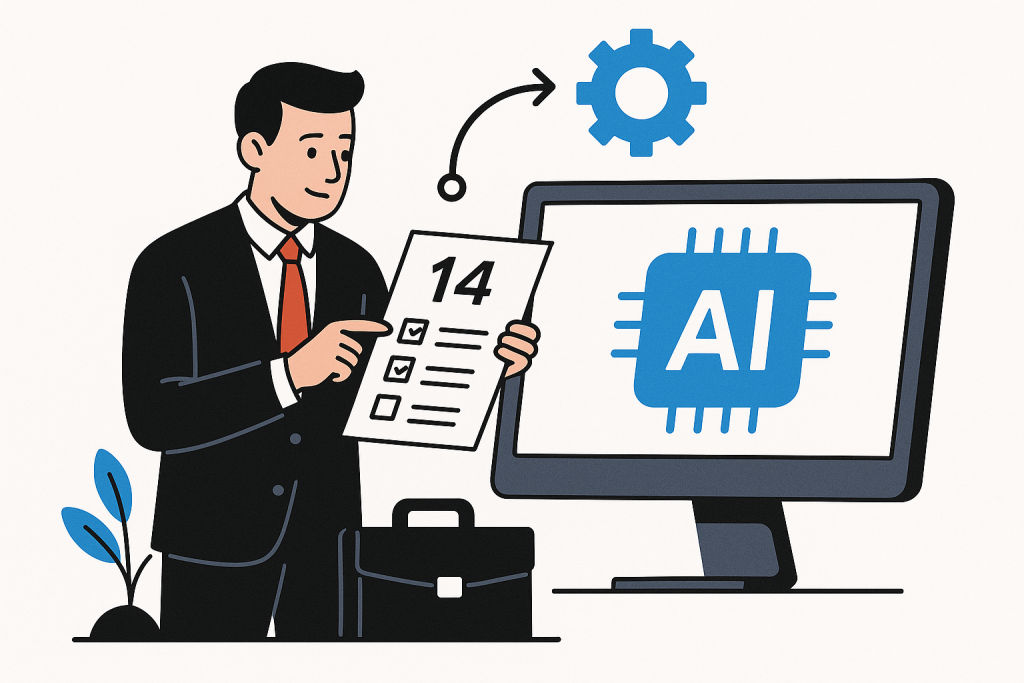
There are a number of tools and platforms on the market for implementing AI. Consider the following factors when choosing:
- Ease of use
- Integration options with existing systems
- Support and training
Popular tools include, for example, Intercom for customer service, Tableau for data analysis, and Zapier for process automation.
Day 5-7: Creating a pilot project
Choose one specific project on which you will test AI. For example, you can create a chatbot to answer frequently asked customer questions. Focus on:
- Defining interaction scenarios
- Collecting data for AI training
- Testing and optimizing performance
A pilot project will allow you to gain valuable experience and feedback.
Day 8-10: Employee training
Successful AI implementation depends on how well prepared your employees are. Provide training that covers:
- The basics of AI and its applications
- How to use new tools and technologies
- How to interpret results and data
Encourage employees to actively participate and share ideas for improvement.
Day 11-12: Implementation and testing
After a successful pilot project and training, it is time for full implementation. Make sure that:
- All systems are properly configured and integrated
- Real-time testing is taking place
- Support is available for troubleshooting
Monitor performance and collect feedback from users.
Day 13-14: Evaluation and optimization
After two weeks, it is important to evaluate the success of the implementation. Consider:
- Did you achieve the set goals?
- What problems occurred and how can you address them?
- What other areas could benefit from AI?
Based on this information, you can optimize processes and plan next steps.
Practical scenarios for using AI in a small business
There are many ways AI can help small businesses. Here are a few practical scenarios:
- Customer service automation: Chatbots can answer frequent questions and free up employees’ time for more complex issues.
- Sales analysis: AI can analyze sales data and predict trends, which helps with inventory planning and marketing strategies.
- Marketing personalization: AI can segment customers and recommend products based on their behavior and preferences.
Limits and challenges of AI implementation
Although AI has many advantages, there are also limits and challenges that need to be considered:
- Costs: Implementing AI can be expensive, especially for small businesses with limited budgets.
- Limited knowledge: A lack of AI knowledge among employees can hinder successful implementation.
- Ethical issues: The use of AI may raise concerns about privacy and ethics that need to be addressed.
FAQ
What are the costs of implementing AI?
Costs can vary significantly depending on the selected tools and the scope of the project. It is important to carry out a thorough cost-benefit analysis.
How long does AI implementation take?
In this article, we focused on a 14-day plan, but the actual implementation time may vary depending on the complexity of the project and the company’s readiness.
How can I train my employees in AI?
There are many online courses and training programs focused on AI. You can also consider working with AI experts who can provide tailored training.
Conclusion
Introducing AI into a small business can be a challenge, but with a realistic plan and the right tools, it is achievable. Track progress, collect feedback, and continuously optimize processes to maximize the benefits of AI for your business.
Sources of illustrative images
The custom illustrative image was created using the OpenAI Images API.
| Service | Service description | Offer |
|---|---|---|
| NordVPN | VPN service for privacy protection and secure connections. | Open offer |
| Semrush | SEO and marketing platform for analysis and traffic growth. | Open offer |
| Make | Advanced visual automation for workflows and integrations. | Open offer |
| Hostinger | Web hosting and domains for fast website launch. | Open offer |
| Fiverr | Marketplace for freelancers and external specialists. | Open offer |
| Adobe | Creative tools for graphics, video, and digital content. | Open offer |
| Canva | Online design tool for graphics, presentations, and social media. | Open offer |
| Jasper | AI tool for marketing copy and content campaigns. | Open offer |
Note: We use affiliate links for listed services. If you purchase through them, we may earn a commission at no extra cost to you.
Doporučení ke čtení

AI meeting notes in Czech: how to measure summary quality and reduce hallucinations

AI for accountants in the Czech Republic: document verification, item matching, and an audit trail without chaos

AI Act 2026 for small businesses in the Czech Republic: practical checklist before August