AI news and trends 2026 for the Czech Republic: what is already realistically changing work in companies this year
AI in companies in the Czech Republic in 2026 is no longer mainly about pilots and internal presentations. The real decisions are made elsewhere: whether a new tool shortens a specific process step, who bears responsibility for the output, how much one processed task costs, and where the line is beyond which automation delivers a worse result than a human. This is exactly where the difference between a useful implementation and an expensive experiment is being decided this year.
The most visible change is simple: companies are stopping buying “AI in general” and are instead acquiring specific functions. Typically, search across internal documents, meeting transcription and summaries, assisted email processing, contract review, helpdesk agent support, or automatic extraction of data from invoices and orders. There is less focus on the number of models and more on the quality of integration with company data, auditability, and the actual operating cost.
If you follow the topic continuously, it is also worth tracking practical tool comparisons in the AI tools category and regularly updated articles in the Artificial Intelligence section. For Czech companies, compatibility with the existing stack is more important than which model is currently getting the most attention on social media.
In this overview, I focus on trends that in 2026 have a real impact on processes, roles, and costs in Czech companies. Each area below answers three practical questions: what makes sense to do, who the change is relevant for, and when it is better not to use the given approach.
1. Enterprise AI is shifting from chatting to tasks over data and documents

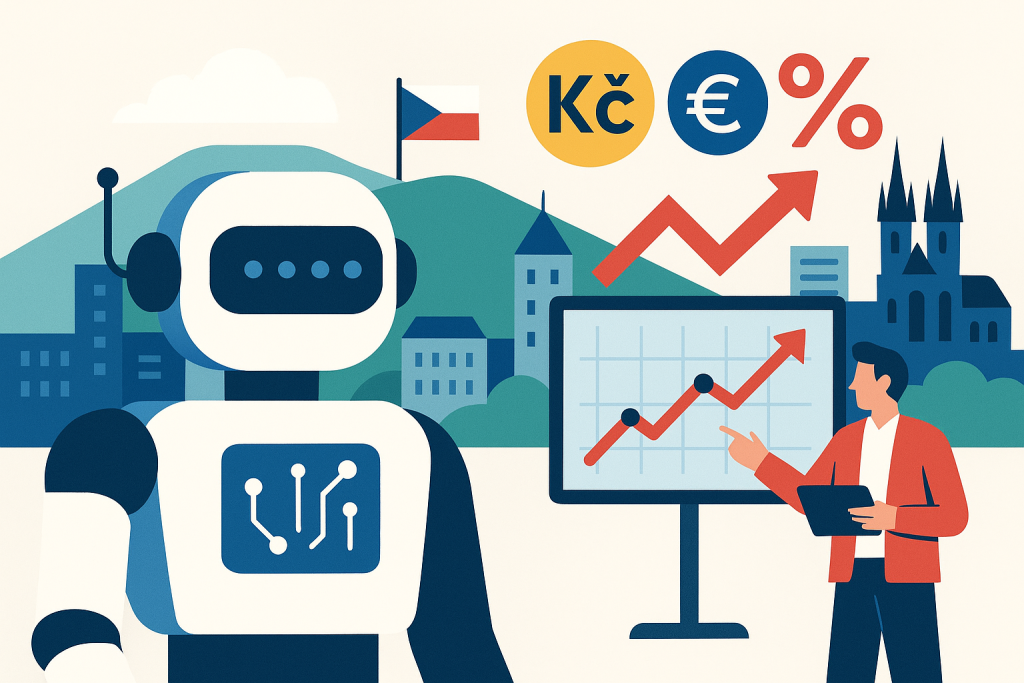
Illustrative context for the topic continues below.
The biggest shift of 2026 is that AI is no longer primarily a conversational layer. In companies, the winning scenarios are those where the model finds, extracts, compares, or prepares something concrete for the next step. A typical example is a query over internal guidelines, contracts, service documentation, or sales history.
In practice, this means a shift toward RAG-type systems, i.e. search over an internal knowledge base with answer generation from retrieved sources. Today this is being implemented, for example, by Microsoft 365 Copilot over content in Microsoft 365, Google Workspace with Gemini over Google Workspace, or the specialized search layer in Atlassian Rovo. The difference compared to a regular chat is fundamental: the user does not need to explain everything manually, and the answer is grounded in company sources.
What to do: start with one narrowly defined use case, for example service FAQ, employee onboarding, or search in internal guidelines. Prepare only a limited corpus of documents, set access rights, and measure answer success on real queries.
Who it is for: companies with a larger volume of repeated queries, especially HR, internal IT support, service, compliance, and customer support.
When not to use it: when the source data is disorganized, duplicated, and has no owner. In that state, AI only distributes the mess faster.
Indicative pricing varies by platform. Microsoft 365 Copilot commonly costs around USD 30 per user per month on top of a Microsoft 365 license, while Google Gemini for Workspace is priced according to plan and features, typically in the tens of USD per user per month. For custom API-based solutions, pricing also includes tokens, vector storage, monitoring, and integration work. For a Czech company, it is therefore often cheaper to buy a function within the existing office environment than to build an internal solution from scratch.
Practical scenario: service department
A technician enters a device serial number and gets a summary: last service interventions, recommended procedure, relevant manual, and an alert about a common defect. If the answer is cited and links to a specific document, search time is reduced from minutes to tens of seconds. If citations are missing, it is not suitable for decision-making in the field.
2. AI agents succeed only where they have a tightly defined process and control

2026 brought greater interest in “agents,” meaning systems that do not just respond with text but perform follow-up steps: create a ticket, retrieve an order, prepare a draft reply, create a task, or process a workflow. But this is also where the most exaggerated expectations arise.
In practice, what works are mainly agents with a narrow assignment, a limited set of tools, and clear approval rules. Examples can be seen in ChatGPT Team / Enterprise with connectors and custom GPTs, in Salesforce Einstein in CRM, or in Zapier Agents for simpler automations between SaaS applications.
What to do: design agents as a work step in a process, not as an autonomous employee. Every agent should have a list of allowed actions, access limits, and human approval for financial, legal, or customer-sensitive operations.
Who it is for: sales teams, support, back office, and operations departments where similar tasks are repeated across several systems.
When not to use it: for open-ended decision-making without rules, for example candidate hiring assessments, approval of terminations, or automatic legal conclusions without review.
As a rough guide, it is important to count on the fact that the cost is not just the license. In agent-based scenarios, money also goes into integration, test sets, permission management, and ongoing supervision. A small pilot may cost in the lower tens of thousands of CZK, but a robust deployment across a department can easily go significantly higher. The return therefore makes sense where the agent saves repeated minutes at high volume, not for sporadic tasks.
Practical scenario: sales assistant in CRM
After a call, the agent writes a summary, fills in CRM fields, suggests a follow-up email, and flags missing data in the sales opportunity. The salesperson only reviews and sends everything. If the same system were to change the offer price or legal terms on its own, that would be risky without additional governance.
3. AI delivers the fastest ROI in support roles, not in strategy

Companies that show fast ROI in 2026 usually do not start with an “AI strategy for everything.” They start in places with high repeatability and low risk of damage if an error occurs. Typically this includes meeting transcription, minutes creation, summarization of email threads, reply suggestions, ticket classification, data extraction from documents, or a first draft of an internal report.
This is clearly visible in tools such as Otter.ai, Fireflies.ai, Zoom AI Companion, or features in Microsoft Teams and Google Meet. The value is not in the transcription itself, but in eliminating dozens of small administrative steps after the meeting.
What to do: identify three tasks employees do daily that do not require original judgment. For each one, measure the time “before” and “after,” and only then decide on company-wide deployment.
Who it is for: sales operations, account management, HR, project management, and management teams with a high number of meetings and emails.
When not to use it: if the company cannot define what a quality output is. Without evaluation criteria, “faster” is quickly mistaken for “good enough,” even when the results contain errors or omit important points.
In practice, the indicative benefit often ranges from single-digit to lower double-digit minutes per person per day. On paper that does not look dramatic, but for a larger team it means dozens of hours per month. It is also important to include the time needed to check the output. If an employee spends five minutes correcting a poor-quality summary, the savings disappear.
4. The winners are tools that fit into Microsoft 365, Google Workspace, and CRM
In the Czech market this year, platforms that do not require a change in work habits are clearly winning. Users do not want to switch to another application just for an AI feature. That is why solutions integrated directly into Outlook, Teams, Word, Excel, Gmail, Docs, Meet, or CRM systems are gaining points.
From a process perspective, this means less training, faster adoption, and above all lower friction in use. From a cost perspective, however, it is necessary to distinguish whether the AI feature is included in the plan or is a separate add-on. For example, in office suites the generative layer is often paid separately, and advanced security or admin features are only available in higher-tier plans.
What to do: before purchasing, write down the list of systems people actually work in and require AI features there. The selection should also include checking data residency, audit logs, DLP policies, and identity management.
Who it is for: companies from roughly 50 employees upward, where permission management, central IT, and a standardized environment already matter.
When not to use it: if your environment is fragmented across many disconnected applications and lacks unified identities. In that state, stack consolidation is usually the more sensible first step.
A typical mistake is buying the “smartest” tool without regard for the company ecosystem. In reality, a less flashy solution often wins because it can work with permissions, calendars, documents, and the company directory. That is exactly why large platforms have an advantage in enterprises, even if they do not always offer the best text generation in laboratory tests.
5. The biggest change is in the roles of people who check the output, not those AI fully replaces
In Czech companies in 2026, what is visible is more a change in job content than the mass replacement of entire professions. There are more roles where people create the first draft less and instead review, decide, and add context more. This applies in marketing, support, analytics, procurement, and internal services.
A well-functioning team today needs not only “AI users,” but also process owners who define the boundaries of use. Typically these are people from operations, compliance, security, data management, and heads of individual departments. Without them, the tool spreads faster than the rules, which leads to hidden costs: errors, duplicate work, and loss of trust in the output.
What to do: rewrite responsibilities for the affected roles. For each process, determine who prepares the prompt, who checks the output, who approves the final step, and who handles the incident when AI makes a mistake.
Who it is for: team leaders, HR, COOs, and operations managers changing workflows across departments.
When not to use it: if management expects pure headcount savings without redesigning the work. Without process change, AI remains just another layer on top of the old way of working.
The practical impact is also visible in hiring. The value of people who can combine domain expertise with working with data, output control, and a basic understanding of risks is rising. Conversely, the value of purely mechanical administrative activities is falling if they are not tied to judgment, communication, or responsibility for the result.
Practical scenario: finance and controlling
An analyst no longer spends half their time manually assembling commentary for the monthly report. AI prepares the first text summary of variances, pulls out anomalies, and suggests questions for the business. But the final interpretation remains with the controller. Where quality input data is missing or metrics are defined differently across departments, AI only speeds up the dispute over which numbers actually apply.
6. The decisive topic is not only security, but also traceability and audit
In 2026, the phrase “we do not use data for training” is no longer enough. Companies are increasingly concerned with whether it is possible to trace what an answer was based on, who had access to what, how long data is retained, and how the tool behaves when an error occurs. In the European environment, this is further driven by legislation and internal governance, especially in regulated industries.
In practice, this shifts preferences toward tools with administration, logging, tenant management, retention policies, and the ability to restrict work with sensitive data. The ability to disable public sharing, define connectors, and separate test environments from production is also important.
What to do: introduce a minimum AI policy even before a broader rollout. It should contain a list of approved tools, prohibited data types, rules for human review, and an obligation to label AI-generated content where it makes sense.
Who it is for: legal departments, IT security, compliance, healthcare, finance, insurance companies, and firms working with sensitive contractual data.
When not to use it: for non-public materials with high sensitivity if the vendor cannot clearly document processing terms, access management, and event logging.
In Czech conditions, a common weakness is that the business starts using public tools before IT and legal set the rules. The result is usually predictable: part of the usage moves into a gray zone and the company loses visibility over its data. It is more sensible to offer approved alternatives quickly, even if at first they do not cover all requirements.
7. Costs will be assessed by price per task, not by number of licenses
Until recently, companies mainly compared the monthly license price. In 2026, that is no longer enough. It makes sense to calculate the price per usefully completed task: a processed ticket, a verified summary, an extracted invoice, a prepared offer, or a resolved query without escalation.
The reason is simple. Licenses with the same price can have completely different economics depending on usage volume, output quality, and the required human review. In API solutions, the price of input and output tokens, context length, number of calls, vector search, workflow orchestration, and monitoring also come into play. In some scenarios, a smaller model with lower latency is also cheaper than the “best” model for everything.
What to do: for each use case, calculate three values: average human time without AI, time with AI including review, and total tool and integration costs. Decide based on the price per completed output, not on the impression from a demo.
Who it is for: CFOs, COOs, procurement, and managers approving budgets for software and automation.
When not to use it: if the quality of the result cannot be measured. A cheaper output without review may actually be more expensive because of errors, complaints, or legal risk.
Indicative example: if a tool costing several hundred to lower thousands of CZK per month saves a specialist 20 minutes a day, the return can be very fast. But if that same person uses the feature once a week, the economics change. That is why a combination is increasingly being introduced: full licenses for intensive users, limited access for others, and API only where there is a high volume of automated tasks.
8. Czech companies are hitting four limits: data, process, responsibility, and language nuances
There is still plenty of marketing around AI, but in practice the same brakes keep recurring. The first is poor-quality data: outdated documents, unclear names, duplicates, and missing metadata. The second limit is process: the company cannot precisely describe how the work is done and what the output should be. The third is responsibility: it is not clear who approves the result and who handles the error. The fourth limit is language and domain nuances, which in Czech and in specific domains are still more sensitive than in English-led demo scenarios.
This is why ambitious company-wide rollouts fail without preparation. The tool is purchased, but people either use it too little or use it incorrectly. The most common reason is not employee resistance, but that AI returns inconsistent results in an inconsistent environment.
What to do: before deployment, conduct a small “AI readiness” audit. It is enough to go through five areas: data quality, process owner, approval rules, security restrictions, and the method of measuring benefit.
Who it is for: small and medium-sized companies that want to deploy AI quickly but do not have a large internal IT team.
When not to use it: when 100% accuracy is required with no room for human review. This applies, for example, to final legal opinions, medical conclusions, or safety-critical instructions without validation.
If you want to choose the right type of solution based on real use rather than trend words, it also makes sense to go through the guides and comparisons on aivyber.cz in the thematic categories. In practice, this shortens the path to deciding whether you need office integration, transcription, workflow automation, or a specialized tool for working with documents.
FAQ: what companies in the Czech Republic most often deal with around AI in 2026
Is it worth buying a standalone AI tool, or are features in Microsoft 365 or Google Workspace enough?
In most common office scenarios, it is sensible to start where employees already work. A standalone tool makes sense when it solves a narrowly specialized need better than the office platform, for example advanced transcription, document processing, or workflow automation.
How much does it cost a company?
Roughly from hundreds of CZK per month for individual specialized services to tens of USD per user per month for enterprise office AI features. For custom API integrations, it is also necessary to count implementation, monitoring, access management, and ongoing maintenance. The license itself is only part of the budget.
Where is the fastest ROI usually found?
In repeated support activities: meeting notes, reply suggestions, ticket work, request sorting, extracting data from documents, and internal search in documentation. By contrast, ROI is usually weak in vague “creative” use cases without clear measurement of the result.
Will AI replace entire positions in companies?
It more often changes job content than eliminates entire roles. Routine administration will decrease, but output review, work with context, approvals, and responsibility for the process will increase. The biggest change is in how work is divided between people and software.
Is it safe to upload company documents into AI tools?
Only if the company has selected an approved tool, set permissions, clear processing terms, and knows what data belongs there and what does not. With public or unapproved tools, it is an unnecessary risk. Governance is what matters, not the vendor’s marketing promises.
Conclusion: in 2026, it is not the “smartest AI” that wins, but the best-embedded process
If I had to summarize this year’s trend in one sentence, it would be this: Czech companies are stopping treating AI as a show and are starting to assess it as an operational tool. That is a healthy change. The greatest value does not come from flashy demos, but from small interventions in specific processes where there is a clear owner, a measurable result, and controlled work with data.
For 2026, a simple rule therefore makes sense. Do not start by choosing a model, but by listing tasks that currently take time and have a predictable output. For each of them, determine what should be shortened, who will check the result, and under what conditions AI must not be used. That is exactly what distinguishes a useful deployment from just another license that ends up having no effect after a few months.
The biggest impact this year does not come from one groundbreaking innovation, but from discipline in selection: fewer promises, more measurement. And that is exactly where Czech companies will either succeed in the coming months or become unnecessarily expensive.
Recommended AI stack for implementation
Choose tools according to your budget and level of automation. Below is a direct overview of services for project implementation.
| Service | Service description | Offer |
|---|---|---|
| NordVPN | VPN service for privacy protection and secure connections. | Open offer |
| Semrush | SEO and marketing platform for analysis and traffic growth. | Open offer |
| Make | Advanced visual automation for workflows and integrations. | Open offer |
| Hostinger | Web hosting and domains for fast website launch. | Open offer |
| Fiverr | Marketplace for freelancers and external specialists. | Open offer |
| Adobe | Creative tools for graphics, video, and digital content. | Open offer |
| Canva | Online design tool for graphics, presentations, and social media. | Open offer |
| Jasper | AI tool for marketing copy and content campaigns. | Open offer |
Note: We use affiliate links for listed services. If you purchase through them, we may earn a commission at no extra cost to you.
Links in the article
- OpenAI
- Zapier
- Microsoft 365 Copilot
- Atlassian Rovo
- Salesforce Einstein
- Otter.ai
- Fireflies.ai
- Zoom AI Companion
Sources of illustrative images
The custom illustrative image was created using the OpenAI Images API.
Doporučení ke čtení

AI Mode in Search: how to change your content strategy when the SERP already provides the answers

Secure data sharing with AI tools: what a small team needs to have in place right away

AI for lawyers: automated initial contract review step by step